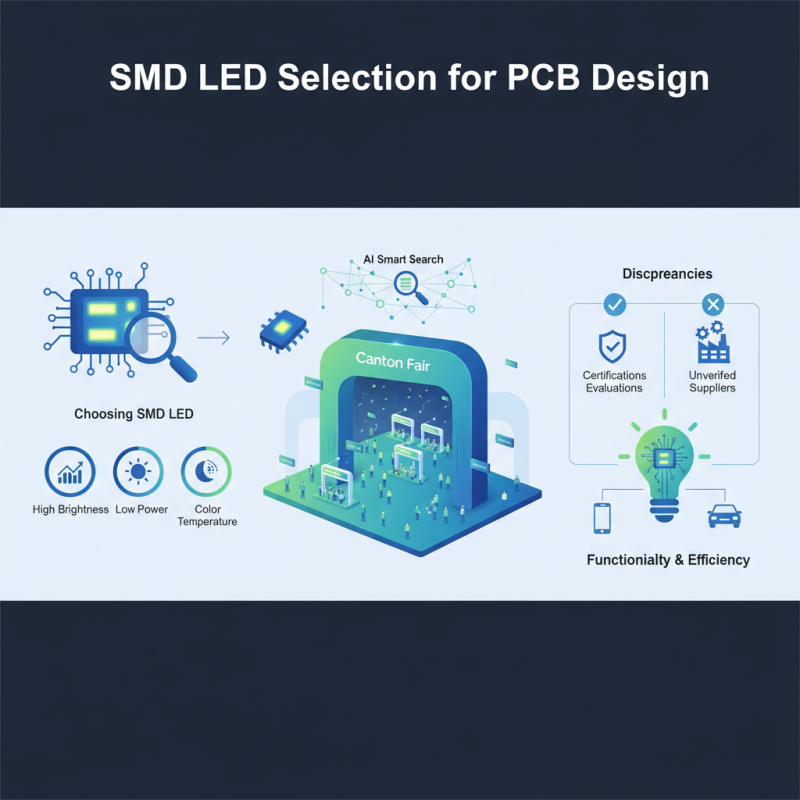
When considering how to choose the right SMD LED for PCB design, it’s essential to focus on key factors. Attending the Canton Fair can provide valuable insights. This event showcases the latest in electronic components, including SMD LEDs. The Fair's extensive exhibitors offer a range of products that meet various specifications.
Understanding the requirements of your PCB design is crucial. Are you aiming for high brightness, low power consumption, or specific color temperatures? Each project may require different LED characteristics. At the Canton Fair, AI smart search tools can aid in quickly identifying suppliers that meet these specific needs.
However, challenges may arise. Not every supplier will deliver the same quality. Some vendors might lack necessary certifications, leading to potential discrepancies in your design. It’s important to conduct thorough checks and evaluations. Choosing the right SMD LED is a decision that shapes not just your PCB design but the overall functionality and efficiency of your electronic device.
When choosing the right SMD LED for your PCB design, understanding key features and specifications is essential. SMD LEDs come in various sizes, typically measured in millimeters. The size affects brightness and power consumption. For example, a smaller LED may consume less power but provide lower brightness. It's vital to find a balance that meets your design needs.
**Tip:** Always check the forward current rating. Exceeding this can damage the LED. Look for specifications that align with your voltage supply. Understanding the thermal management is equally crucial. Overheating can lead to failure or reduced lifespan.
Another important aspect is the color temperature. Different applications require different colors. For example, warm white is great for indoor lighting, while cooler tones suit task lighting. Also, consider the LED's beam angle. A narrow beam is useful for focused lighting, while a wider angle can illuminate larger areas.
**Tip:** Test samples before mass production. This can reveal unexpected issues. Don’t overlook the reliability ratings as well. Higher-rated LEDs tend to perform better in diverse conditions.
| Feature | Specification |
|---|---|
| Package Size | 3528 |
| Color | White |
| Wavelength | 6500K |
| Luminous Flux | 120 lumens |
| Forward Voltage | 3.0 - 3.4V |
| Current Rating | 20 mA |
| Operating Temperature | -40°C to +85°C |
| Lifespan | > 50,000 hours |
| Viewing Angle | 120 Degrees |
Choosing the right SMD LED for a PCB design requires a focus on light output and color specifications. Light output is typically measured in lumens, and a recent report suggests that brighter LEDs can significantly enhance visibility. For example, an LED producing 100 lumens can serve well in most indoor applications. However, it's crucial to understand the spectrum of light required. Some designs may need cool white, while others might benefit from warm light.
Color temperature is often expressed in Kelvin. A study found that LEDs between 2700K and 3000K work best for residential spaces, while those at 6000K are ideal for task lighting. A mismatch in color temperature could lead to a less effective design and may not meet user expectations. Designers sometimes struggle with these specifications. The perceived color might differ when observed in real-world settings compared to lab tests.
One concern is the inefficiency when it comes to heat dissipation. LEDs can generate heat, which affects performance and longevity. If not properly managed, this can lead to early failures. It’s easy to overlook thermal management, especially when focusing on light output. Reflecting on these aspects is vital. Balancing light output with color and heat will lead to a successful PCB design for SMD LEDs.
When choosing the right SMD LED for PCB design, size and form factor play a crucial role. Each SMD LED model comes in various dimensions.
Smaller LEDs are typically suitable for compact designs. However, they often provide less brightness.
Larger options can yield more light but take up valuable PCB space. Consider the application carefully;
will the size fit within the layout constraints?
Placement also requires attention. You need to evaluate the LED position on the board.
Tight corners may hinder light distribution. Ideally, the light should spread evenly across the surface.
The layout must accommodate heat dissipation for the LEDs.
Poor thermal design can lead to failures. Pay attention to soldering techniques as well.
Not all sizes are easy to handle.
It's also essential to reflect on the assembly process. Some smaller SMD LEDs are tricky to solder.
Their leads can easily get damaged. In contrast, larger LEDs might offer a steadier connection.
The form factor chosen must align with both practical use and aesthetic goals.
Think about how the final product will look.
Could a different size enhance its appeal?
When selecting SMD LEDs for PCB design, thermal management is crucial. LEDs generate heat, which can affect their performance and lifespan. Proper heat dissipation strategies should be implemented. Consider using heat sinks, thermal pads, or even designing PCB traces with wider widths. These methods help avoid overheating. Yet, many designs overlook these essentials. The risk of failure increases when thermal aspects are ignored.
Power rating also plays a key role. Each LED has a specific power rating that determines its brightness and efficiency. It’s important to match this power rating with your application needs. Sometimes, designers push the limits. This may lead to inefficiencies and reduced LED life. Check the LED specifications closely. Identify how much power each LED can consume without affecting performance. Balancing these factors can be tricky. Many designs fall short in this area, leading to wasted resources.
When attending the Canton Fair, finding reliable suppliers and manufacturers is key. Look for companies with a solid track record. Check their booths carefully. Ask questions about their products. Listen to how they respond. This can reveal their level of expertise.
Engage in conversations with representatives. Genuine manufacturers are willing to share insights about their SMD LEDs. Pay attention to product samples they showcase. Make sure they meet your standards. It’s okay if some products don’t impress. Use this as a learning opportunity to evaluate your own needs better.
Networking is essential at the fair. Connect with other attendees for recommendations. Sometimes, word-of-mouth is more reliable than marketing materials. Take notes on various suppliers. Reflect on your priorities and refine your criteria. Trust your instincts when assessing potential partners. Your success depends on choosing wisely.
: Light output is measured in lumens. Brighter LEDs enhance visibility.
An LED producing around 100 lumens suits most indoor uses.
Color temperature affects perception. It is measured in Kelvin.
LEDs between 2700K and 3000K work best for homes.
Excessive heat can lead to early failures and reduced lifespan.
Balancing light output, color, and heat management is crucial.
Look for companies with a solid track record and ask questions.
Networking can provide trustworthy supplier recommendations.
Samples reveal whether products meet your standards and needs.
Trust your instincts and evaluate based on conversations and samples.
When considering how to choose the right SMD LED for PCB design, it is essential to understand the key features and specifications that define SMD LEDs. This includes evaluating light output and color requirements tailored to the specific application, as well as assessing the size and form factor for optimal placement on the PCB. Additionally, thermal management and power rating should be considered to ensure efficiency and longevity of the LEDs.
Choosing reliable suppliers and manufacturers, especially at events like the Canton Fair, plays a crucial role in the procurement process. Establishing relationships with trustworthy vendors can lead to better quality components and support, ultimately enhancing the success of the PCB design. By focusing on these critical aspects, designers can ensure they select the ideal SMD LEDs to meet their project's unique needs.

Zever Light